
World War II · Medal of Honor
Second Lieutenant (Technical Sergeant at the time of action), Company B, 135th Infantry Regiment, 34th Infantry Division, U.S. Army
ACTION: MAY 23, 1944 — NEAR CISTERNA, ITALY
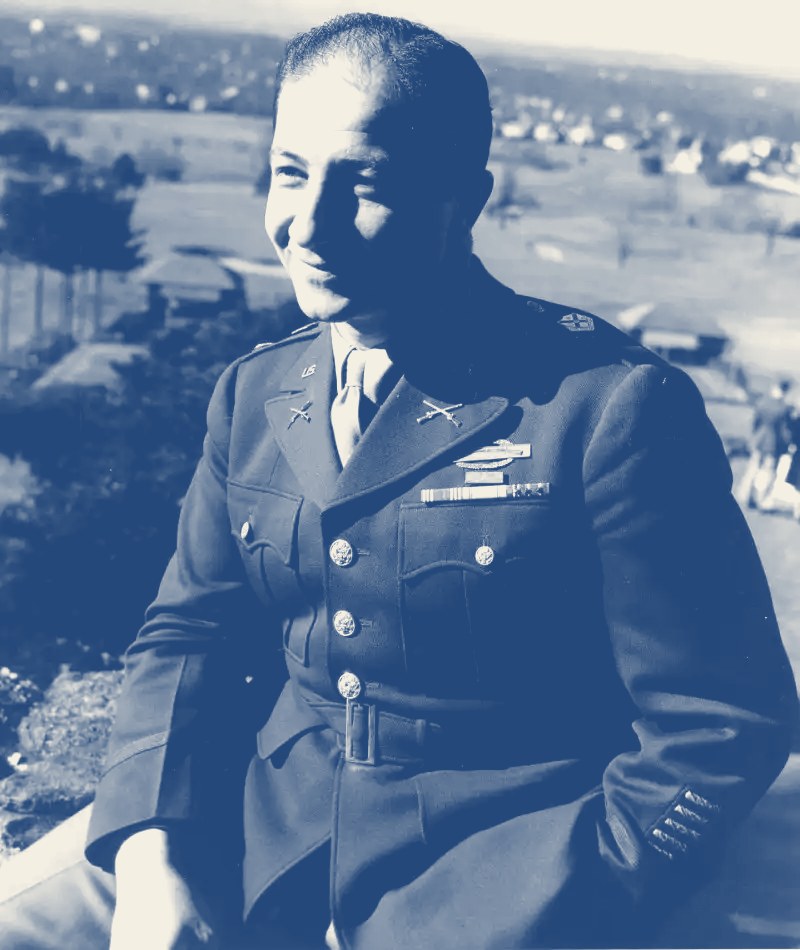
His Story
Ernest Herbert Dervishian was born in Richmond on August 10, 1916, to Hagop and Mary Dervishian, Armenian immigrants who ran a candy store. He studied at the University of Richmond, was admitted to the Virginia bar in December 1937, and took his law degree from the university's T.C. Williams School of Law the following June. He enlisted as a private in September 1941, and by the spring of 1944 he was a technical sergeant in Italy with the 34th "Red Bull" Infantry Division.
On May 23, 1944, during the Anzio breakout near Cisterna, Dervishian and four of his men got far ahead of their company. At a railroad embankment they found Germans in dugouts. With his men covering him, Dervishian walked forward firing his carbine and forced ten to surrender; his men took fifteen more. Nine ran for a ridge; he chased them down alone. In the vineyard beyond, a machine gun fifteen yards off pinned them down. He played dead until it paused, then rushed it with a grenade and his carbine and captured the crew. He sent his men back and stayed, working the captured gun against a second nest and a machine pistol against a dugout behind him until five came out of each. Alone, he found a third gun beside a house and forced six more to surrender. Fifty-four Germans surrendered in about twenty-five minutes, thirty-nine of them to Dervishian himself.
He received a battlefield commission to second lieutenant in July 1944, the month after Rome fell. General Mark Clark presented the Medal of Honor at Piamaggio, Italy, on January 12, 1945. Richmond declared February 1 Dervishian Day and gave him a parade, and a reported 30,000 turned out. "Countless others performed acts equal to mine," he said. "They were not so lucky."
He practiced law in Richmond, served as an assistant Commonwealth's attorney from 1947 to 1959, served a term as National Vice Commander of the American Legion in 1946 and 1947, and retired from the Army Reserve as a colonel in 1968. He died in Richmond on May 20, 1984.
For conspicuous gallantry and intrepidity at the risk of life above and beyond the call of duty on 23 May 1944, in the vicinity of Cisterna, Italy. Second Lt. Dervishian (then TSgt.) and four members of his platoon found themselves far ahead of their company after an aggressive advance in the face of enemy artillery and sniper fire. Approaching a railroad embankment, they observed a force of German soldiers hiding in dugouts. Second Lt. Dervishian, directing his men to cover him, boldly moved forward and, firing his carbine, forced 10 Germans to surrender. His men then advanced and captured 15 more Germans occupying adjacent dugouts. The prisoners were returned to the rear to be picked up by advancing units. From the railroad embankment, 2d Lt. Dervishian and his men then observed nine Germans who were fleeing across a ridge. He and his men opened fire and three of the enemy were wounded. As his men were firing, 2d Lt. Dervishian, unnoticed, fearlessly dashed forward alone and captured all of the fleeing enemy before his companions joined him on the ridge. At this point four other men joined 2d Lt. Dervishian's group. An attempt was made to send the four newly arrived men along the left flank of a large, dense vineyard that lay ahead, but murderous machine-gun fire forced them back. Deploying his men, 2d Lt. Dervishian moved to the front of his group and led the advance into the vineyard. He and his men suddenly became pinned down by a machine gun firing at them at a distance of 15 yards. Feigning death while the hostile weapon blazed away at him, 2d Lt. Dervishian assaulted the position during a halt in the firing, using a hand-grenade and carbine fire, and forced the four German crewmembers to surrender. The four men on the left flank were now ordered to enter the vineyard but encountered machine-gun fire which killed one soldier and wounded another. At this moment the enemy intensified the fight by throwing potato-masher grenades at the valiant band of American soldiers within the vineyard. Second Lt. Dervishian ordered his men to withdraw; but instead of following, jumped into the machine-gun position he had just captured and opened fire with the enemy weapon in the direction of the second hostile machine-gun nest. Observing movement in a dugout two or three yards to the rear, 2d Lt. Dervishian seized a machine-pistol. Simultaneously blazing away at the entrance to the dugout to prevent its occupants from firing and firing his machine gun at the other German nest, he forced five Germans in each position to surrender. Determined to rid the area of all Germans, 2d Lt. Dervishian continued his advance alone. Noticing another machine-gun position beside a house, he picked up an abandoned machine-pistol and forced six more Germans to surrender by spraying their position with fire. Unable to locate additional targets in the vicinity, 2d Lt. Dervishian conducted these prisoners to the rear. The prodigious courage and combat skill exhibited by 2d Lt. Dervishian are exemplary of the finest traditions of the U.S. Armed Forces.
— Medal of Honor citation, presented January 12, 1945
His Legacy Today
Monumental Honor and the University of Richmond revived Dervishian Day in February 2023, seventy-eight years after the first one, honoring his family at halftime of a Spiders basketball game. The celebration now falls each November at a Spiders football game, with his daughters present. Monumental Honor and Troutman Pepper Locke award the $5,000 Ernest H. Dervishian Memorial Scholarship there to a University of Richmond law student: Rachel Slaughter Thury in 2024 and Henry Dyke in 2025.
Learn more:Official record at the Congressional Medal of Honor Society
This website was designed by GuildeHall Creative