
World War II · Medal of Honor
Lieutenant Commander, USS Tirante (SS-420), U.S. Navy (rose to Captain)
ACTION: APRIL 14, 1945 — QUELPART ISLAND HARBOR, KOREA
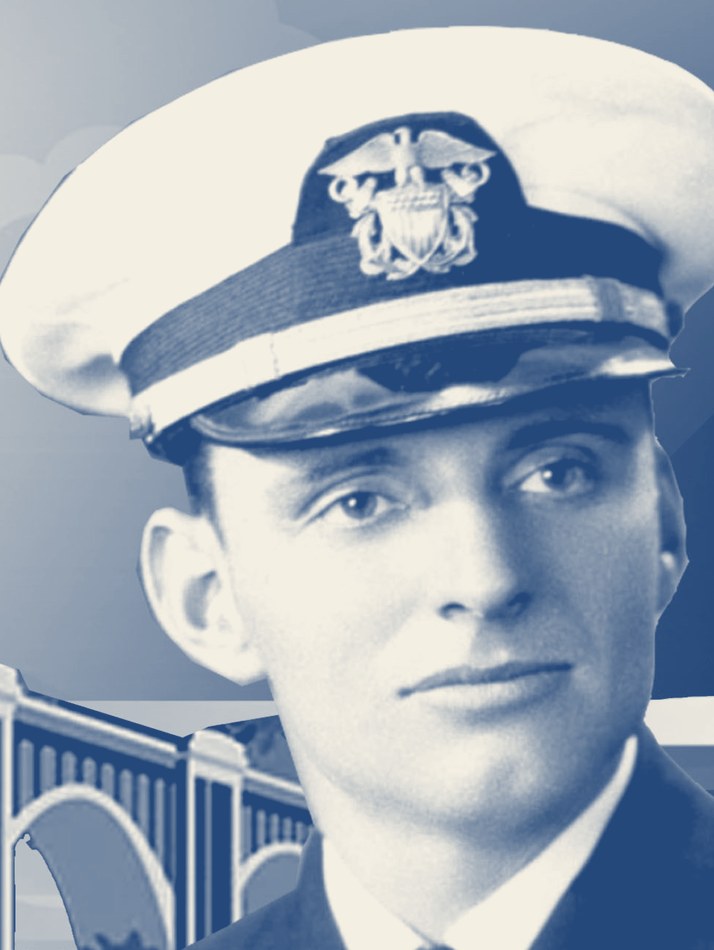
His Story
George Levick Street III was born in Richmond on July 27, 1913. He graduated from St. Christopher's School in 1931, enlisted in the Naval Reserve, and entered the U.S. Naval Academy two years later, graduating in 1937. In 1940 he volunteered for submarines. He earned two Silver Stars aboard USS Gar and took command of the new USS Tirante in July 1944.
On her first war patrol, before dawn on April 14, 1945, Street took Tirante into the harbor at Quelpart Island on the surface. The water was too shallow to dive. The harbor was mined and shoal-obstructed, patrolled by surface vessels and aircraft, and watched by five shore-based radar stations. Street went in with the crew at battle stations. Twelve hundred yards offshore, Tirante put two torpedoes into the Japanese ammunition ship Juzan Maru, and the explosion lit the submarine up for every gun in the harbor. Two escorts came after her. Street fired his last two torpedoes and sank them both. Tirante cleared the harbor at emergency full speed and dove deep as depth charges fell behind.
Word of President Roosevelt's death had reached the boat shortly before the attack. Street's report to Pacific command read: "Three for Franklin ... sank ammunition ship, two escorts." Truman presented Street's Medal at the White House on October 5, 1945. His executive officer on that patrol was Edward L. Beach, who later wrote the novel Run Silent, Run Deep.
Two months later Tirante entered Nagasaki Harbor, sank another ship, and wrecked the docking facilities. Street received the Navy Cross for that second patrol. He served twenty more years, taught naval science at MIT, and retired a captain in 1966. He settled in Andover, Massachusetts, and died there on February 26, 2000, at 86.
For conspicuous gallantry and intrepidity at the risk of his life above and beyond the call of duty as commanding officer of the U.S.S. Tirante during the first war patrol of that vessel against enemy Japanese surface forces in the harbor of Quelpart Island, off the coast of Korea on 14 April 1945. With the crew at surface battle stations, Comdr. (then Lt. Comdr.) Street approached the hostile anchorage from the south within 1,200 yards of the coast to complete a reconnoitering circuit of the island. Leaving the 10-fathom curve far behind, he penetrated the mined and shoal-obstructed waters of the restricted harbor despite numerous patroling vessels and in defiance of five shore-based radar stations and menacing aircraft. Prepared to fight it out on the surface if attacked, Comdr. Street went into action, sending two torpedoes with deadly accuracy into a large Japanese ammunition ship and exploding the target in a mountainous and blinding glare of white flames. With the Tirante instantly spotted by the enemy as she stood out plainly in the flare of light, he ordered the torpedo data computer set up while retiring and fired his last two torpedoes to disintegrate in quick succession the leading frigate and a similar flanking vessel. Clearing the gutted harbor at emergency full speed ahead, he slipped undetected along the shoreline, diving deep as a pursuing patrol dropped a pattern of depth charges at the point of submergence. His illustrious record of combat achievement during the first war patrol of the Tirante characterizes Comdr. Street as a daring and skillful leader and reflects the highest credit upon himself, his valiant command, and the U.S. Naval Service.
— Medal of Honor citation, presented October 5, 1945
His Legacy Today
Street asked that half his cremated remains be scattered at sea from a submarine and half be buried at Arlington. Both requests were carried out, and he was interred at Arlington on March 15, 2000. A bridge in Andover, Massachusetts, is named for him. In Richmond he is one of four Recipients in our mural at 1903 W. Main Street.
Learn more:Official record at the Congressional Medal of Honor Society
This website was designed by GuildeHall Creative